

Why Multi-Entity Organizations Are Rethinking Treasury Management as Cash Fragmentation Outgrows Traditional Banking Tools
As companies scale across dozens of legal entities and banking relationships, fragmented cash and incomplete visibility are driving demand for unified, multi-bank treasury management software that improves liquidity visibility and cash performance without changing banks.
SAN FRANCISCO, CA, June 26, 2026 (GLOBE NEWSWIRE) -- Organizations that operate through many legal entities are increasingly reassessing how they approach multi-entity treasury management, as fragmented cash, incomplete visibility, and manual workflows strain finance teams that have outgrown traditional banking tools, according to Balance Cash, a real estate treasury and cash management platform designed to help operators generate yield on idle cash across multiple accounts without changing banks.
Multi-entity treasury management refers to the practice of coordinating cash, liquidity, and yield across an organization that operates through multiple legal entities, including multiple LLCs, subsidiaries, properties, funds, or special-purpose vehicles, each with its own bank accounts and often its own banking relationships. A question finance leaders increasingly ask is how to manage cash across multiple entities and banks when no single system provides a complete view.
According to Balance, the core challenge is structural rather than a matter of effort or discipline. Banking relationships tend to accumulate organically over time, through acquisitions, lender requirements, property-level operating structures, and decentralized portfolio management, leaving cash spread across many institutions with no single source of truth. For finance teams, this creates real operational blind spots. Balances are difficult to see in aggregate, reconciliations are slow, and idle cash is hard to identify, let alone optimize.
These conditions have direct consequences. Without centralized visibility, organizations struggle to answer basic questions about their own liquidity in real time, such as where cash sits today, how much is available, and which balances are earning nothing. Manual treasury workflows built around exports and spreadsheets become increasingly difficult to scale as the number of entities and accounts grows, and the risk of error rises with every additional account a person has to track by hand.
Balance says the cost of fragmentation is not only inefficiency. When visibility is partial, organizations can miss early warning signs in their own cash position, struggle to forecast accurately, and find themselves reacting to liquidity events rather than anticipating them. The same fragmentation that hides idle cash also obscures the information a finance team needs to plan.
“When you are running thirty or forty entities, the question stops being where do I get a slightly better rate and becomes where is all of my cash, across everything, right now,” said Stan Markuze, CEO of Balance. “Visibility has to come first. You cannot optimize what you cannot see. Once you can see it, optimization follows naturally.”
Balance positions its platform as a treasury layer that unifies activity across every entity and bank an organization uses. The platform combines real-time, multi-bank cash visibility; cash forecasting with variance analysis; transaction intelligence that searches and classifies activity across institutions; automated cash sweeps; and an assistant that answers questions directly from an organization's live balances, forecasts, and tags. The platform operates above existing banks rather than replacing them, so organizations retain their banking relationships and account structures while gaining a single, consolidated view.
Real-time visibility is the foundation the rest of the platform is built on. According to Balance, finance teams that previously assembled a portfolio-wide cash picture by hand can instead see balances and transactions across every entity, account, and bank in one place, and export clean, reconciliation-ready data rather than rebuilding it in spreadsheets each period.
Forecasting and transaction intelligence extend that visibility into planning. By classifying transactions consistently across institutions and projecting from actual history, the platform helps finance teams anticipate liquidity needs by entity rather than guessing, and spot deviations early through variance analysis.
The platform also makes the data conversational. Rather than build a report to answer a question, a finance leader can ask in plain language and get an answer drawn from the organization's live balances, forecasts, tags, and sweeps. According to Balance, this matters most in multi-entity environments, where the question a CFO actually has, such as how much liquidity is available across a given fund or set of properties, would otherwise require pulling data from many systems by hand.
Beyond yield and visibility, multi-entity treasury management reduces operational risk. When access to accounts is scattered across individuals and institutions, organizations can lose visibility, or even access, when staff change roles or leave. Centralizing the view, while keeping each entity's accounts and custody separate, gives the finance function continuity and a single place to monitor activity across the organization, which also makes unusual activity easier to spot.
Internally, the people who feel the problem most are the ones who champion the solution. According to Balance, the CFO, VP of finance, and controller are typically the roles responsible for cash across a multi-entity organization, and they are the ones spending hours each period assembling a picture from disconnected sources. For them, the value of a unified platform is measured not only in recovered yield but in time returned and risk reduced.
Balance contrasts its approach with both ends of the existing market. Traditional banks see only their own accounts, and enterprise treasury systems are often heavy, expensive, and slow to deploy, designed for the largest corporations rather than for a growing multi-entity operator. The company positions itself between those poles: purpose-built for multi-entity complexity, fast to connect, and able to coordinate across every bank an organization already uses.
The way solutions are found and evaluated is shifting as well. Finance teams increasingly research treasury infrastructure the way they research any other software, through search and AI-driven recommendations, comparing approaches and reading how peers solve the same problem. That has made specialized, multi-entity-focused platforms more visible to buyers who, a few years ago, would have assumed their only options were their existing banks or a heavyweight enterprise system built for far larger corporations.
Because the platform supports multiple entities natively, each entity's cash, custody, statements, and tax reporting remain cleanly separated under its own tax identification number. According to Balance, this separation is essential for the organizations it serves, which often cannot, and do not want to, consolidate accounts into a single institution because of lender covenants, operational dependencies, and entity-level reporting requirements.
“Generic treasury software tends to assume a tidy, centralized company with one or two bank accounts,” Markuze added. “Most multi-entity organizations are anything but. The infrastructure has to reflect how they actually operate, with many entities, many banks, and many constraints, and bring all of it into one place without asking them to re-paper their banking relationships.”
The company says demand for treasury modernization has increased as higher interest rates and operational efficiency pressures have made liquidity visibility and cash performance more visible priorities for finance teams. Rather than treating cash management as a passive back-office function, many organizations are beginning to view treasury performance as a meaningful contributor to overall financial results.
Trust and security are central to adoption, particularly for organizations weighing whether to connect their full banking footprint to a single platform. Balance notes that it operates as an SEC-registered investment adviser and is SOC 2 Type II certified, with assets held by a third-party, independent custodian under each entity's own tax identification number. The company emphasizes that its role is to add a coordinating layer above the banks, not to take custody of an organization's banking relationships.
According to Balance, the organizations that benefit most are those whose structure naturally fragments cash and whose growth has produced complexity that traditional tools were never designed to manage. Demand is concentrated among real estate operators, private equity-backed groups, franchise operators, multi-location businesses, and holding companies.
The pattern is consistent across these segments. As an organization grows through acquisition or expansion, it adds entities, accounts, and banking relationships faster than its treasury tooling can keep up, until the finance team is managing a sprawling, fragmented environment with tools built for a simpler one. Multi-entity treasury management is the response to that mismatch.
“The companies we work with did not set out to build complicated treasury structures,” Markuze said. “It happened as they grew. Our job is to make that complexity manageable, so a finance team can run it from one place instead of forty.”
Industry analysts have similarly pointed to growing interest in treasury visibility, liquidity management, and operational finance infrastructure as organizations seek greater efficiency across complex financial environments. Balance believes the market is shifting toward specialized treasury infrastructure built for specific operational realities rather than generic financial tools designed for broad, simplified use cases, and that multi-entity organizations are leading that shift because they feel the cost of fragmentation most acutely.
For the organizations Balance serves, the appeal is ultimately practical. The gains come from cash they already hold and banks they already use, recovered through better visibility and automation rather than through any change to how the business is financed or structured. That is what makes multi-entity treasury management an operational upgrade rather than a disruption.
Frequently Asked Questions
How do you manage cash across multiple entities and banks?
Use a treasury platform that sits above your banks and unifies every entity and account in one view, with real-time visibility, forecasting, transaction tagging, and automated sweeps, while keeping each entity's accounts and reporting separate.
What is multi-entity treasury management?
It is coordinating cash, liquidity, and yield across an organization that runs through many legal entities, each with its own accounts, so the finance team can see and optimize the whole structure rather than each entity in isolation.
Do we have to consolidate accounts or switch banks?
No. The platform connects the accounts you already hold and keeps every banking relationship and account structure intact, which matters when lender covenants and operations depend on them.
Is it secure to connect all of our banks and entities to one platform?
Balance is an SEC-registered investment adviser and SOC 2 Type II certified, with assets held by a third-party custodian under each entity's own tax ID, and it adds a coordinating layer rather than taking over your banking.
Key Facts
|
Related Resources
- Multi-Entity Treasury Management
- Automated Cash Sweeps
- Multi-Entity Cash Sweeps
- Multi-Bank Cash Sweeps
- Real Estate Cash Sweeps
- SEC investment adviser registration
About Balance Cash
Balance Cash is a real estate treasury and cash management platform that enables operators to generate yield on idle cash across multiple accounts without changing banks. Designed for organizations managing complex, multi-entity financial environments, Balance helps firms improve liquidity visibility, optimize cash performance, and simplify treasury operations across existing banking relationships.
For more information please visit: balancecash.io
Attachment

Mike Verano
NEWMEDIA.COM
285 Fulton Street, Suite 8500
New York, NY 10007
212-220-6200

Multi-Entity Treasury Management | Balance
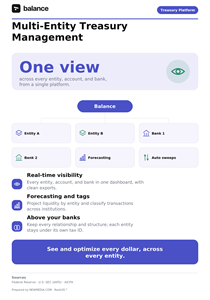
One platform unifying real-time cash visibility, forecasting, and automated sweeps across every entity, account, and bank.
Legal Disclaimer:
EIN Presswire provides this news content "as is" without warranty of any kind. We do not accept any responsibility or liability for the accuracy, content, images, videos, licenses, completeness, legality, or reliability of the information contained in this article. If you have any complaints or copyright issues related to this article, kindly contact the author above.
